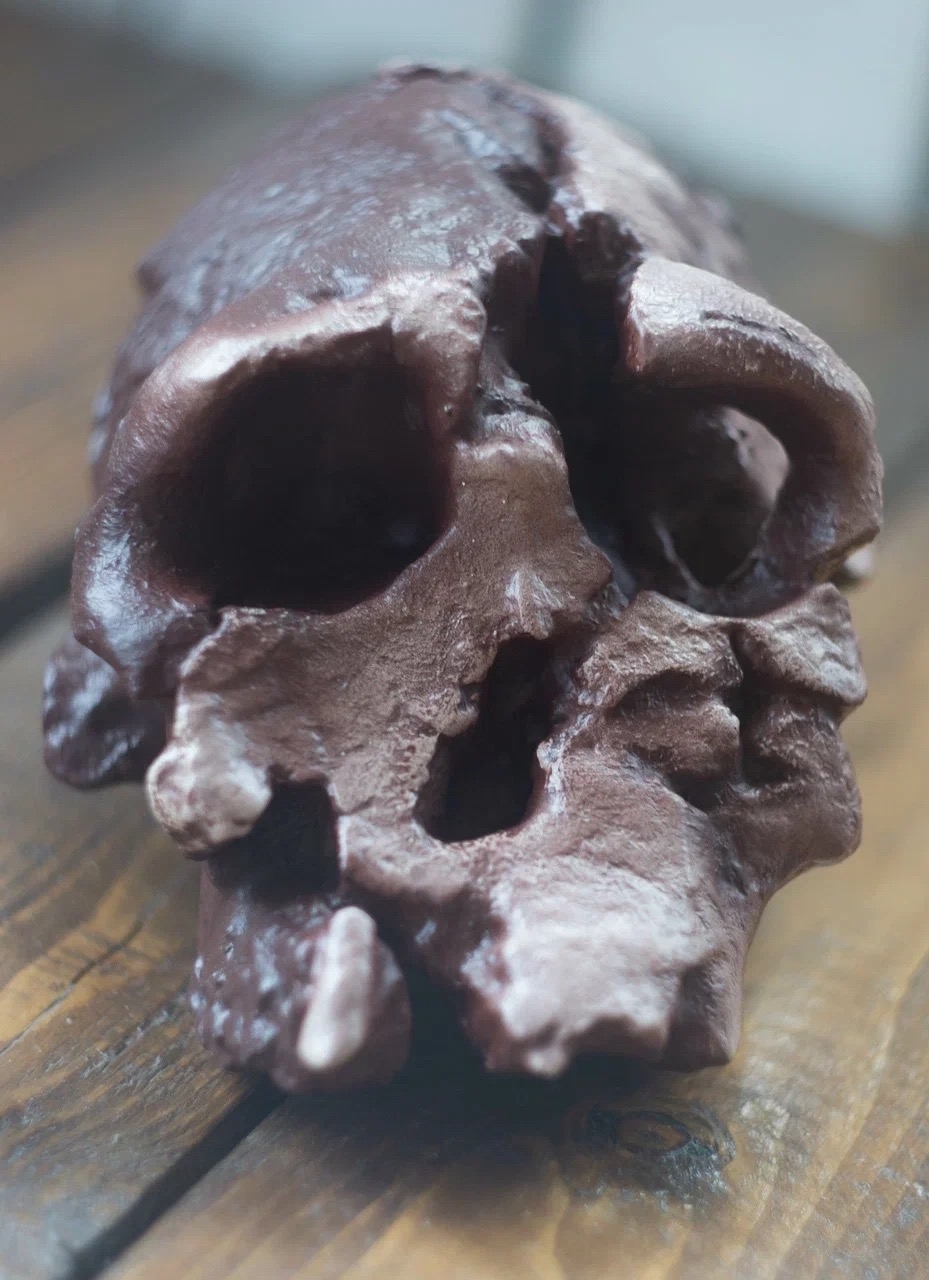
When we imagine a "human ancestor," we usually picture something primitive: a massive jaw, a sloping forehead, and a receding chin. That's how we know Lucy the Australopithecus — the legendary "mother of humanity" who lived about 3.2 million years ago. But imagine that 3.5 million years ago, a creature walked across the African savanna that looked… almost modern. Its name is Kenyanthropus platyops (the flat-faced Kenyan man), and its skull is not just a fossil — it's one of the most intriguing faces in paleoanthropology.
A Portrait of Lucy's Contemporary
The discovery made by Meave Leakey's team on the shores of Kenya's Lake Turkana in 1999 literally shook the scientific world. If Lucy's skull looks typically ape-like with a protruding muzzle, the skull KNM-WT 40000 (the find's official name) possesses features that scientists were used to associating with much later humans.
Here are the key features of this "face":
- Flat profile: Unlike the forward-projecting face of australopithecines, the Kenyantrop's face is flat. It lacks the so-called "anterior pillars" — bony columns on either side of the nasal opening that Lucy has.
- Small teeth: Kenyantrop has surprisingly small molars for such an early hominid. The chewing surface area of its teeth falls at the lower end of even australopithecine variations, which is generally atypical for ancient species.
- Brain shape: Although brain volume remained chimpanzee-like (about 400–450 cubic cm), the shape of the braincase and the facial structure were closer to human than to primitive.
So it appears that 3.5 million years ago, at least one hominid species with "progressive" features existed on the planet, living in parallel with the "classic" Lucy. It's as if, during the age of dinosaurs, we found a mammal with modern fur and warm-bloodedness — too early, too strange.
The Debate of the Century: Who Is He to Us?
The discovery of such a strange mosaic of traits (flat face + small brain) sparked fierce debates that continue to this day. Scientists have three main theories:
1. A separate genus — a direct human ancestor
The Leakey family, who discovered the find, insist that Kenyanthropus is not an australopithecine. They gave it a new generic name, suggesting that it was from this flat-faced branch that the genus Homo (Human) descended, while the famous Lucy is just a dead-end branch. Furthermore, they suggest that the mysterious Homo rudolfensis (another "contentious" human species dated to 2 million years ago) is actually a late surviving Kenyantrop.
2. A distorted australopithecine (Deformation)
The main argument of skeptics, led by Tim White: the skull is broken into 1100 pieces and heavily deformed. Perhaps the "flat face" is an optical illusion caused by bones shifting under sediment pressure. In their view, this is just a strange individual of Australopithecus afarensis.
3. An evolutionary experiment
A third group believes that Kenyantrop is a separate species of australopithecine that specialized in a different diet (niche resource partitioning), which gave it such unique facial anatomy, but it went extinct without leaving descendants.
A Tangled Bush Instead of a Straight Line
Whichever theory you lean toward, the significance of the Kenyantrop skull is enormous. It shattered the old, neat theory that evolution was an arrow pointing straight from Lucy to humans. Before 1999, it was thought that only one hominid species — A. afarensis — lived in Africa 3–4 million years ago. Now we know that diversity existed even back then.
Our family tree is not a single-trunk oak tree. It is a tangled, dense bush. Kenyantrop is one of its most mysterious knots.
The Hand of Kenyantrop?
There is another detail that makes this creature even more significant. Near the site where the skull was found, at Lomekwi, the oldest stone tools on the planet were discovered, dated to 3.3 million years ago. They are called Lomekwian tools. They are 700,000 years older than any other known tools.
There is no direct proof that Kenyantrop made these tools. But at that time, it was the only species in that area with a sufficiently "advanced" hand and brain to conceive of knapping stones. If this is confirmed, then the first technologist on Earth walked with a flat, human-like face and a small brain, disproving the myth that intelligence depends directly on brain volume.
Remember: Evolution does not tolerate oversimplification. It is winding and full of unexpected twists. The Kenyantrop skull is a reminder that we have only just begun to read this complex book, and on every page, surprises await us. Perhaps Lucy is not our grandmother at all, but merely a distant aunt, while the real ancestor wore the flat face of a Kenyan.
Order hominid skull replica in our shop.
